Sunday, August 6, 2017

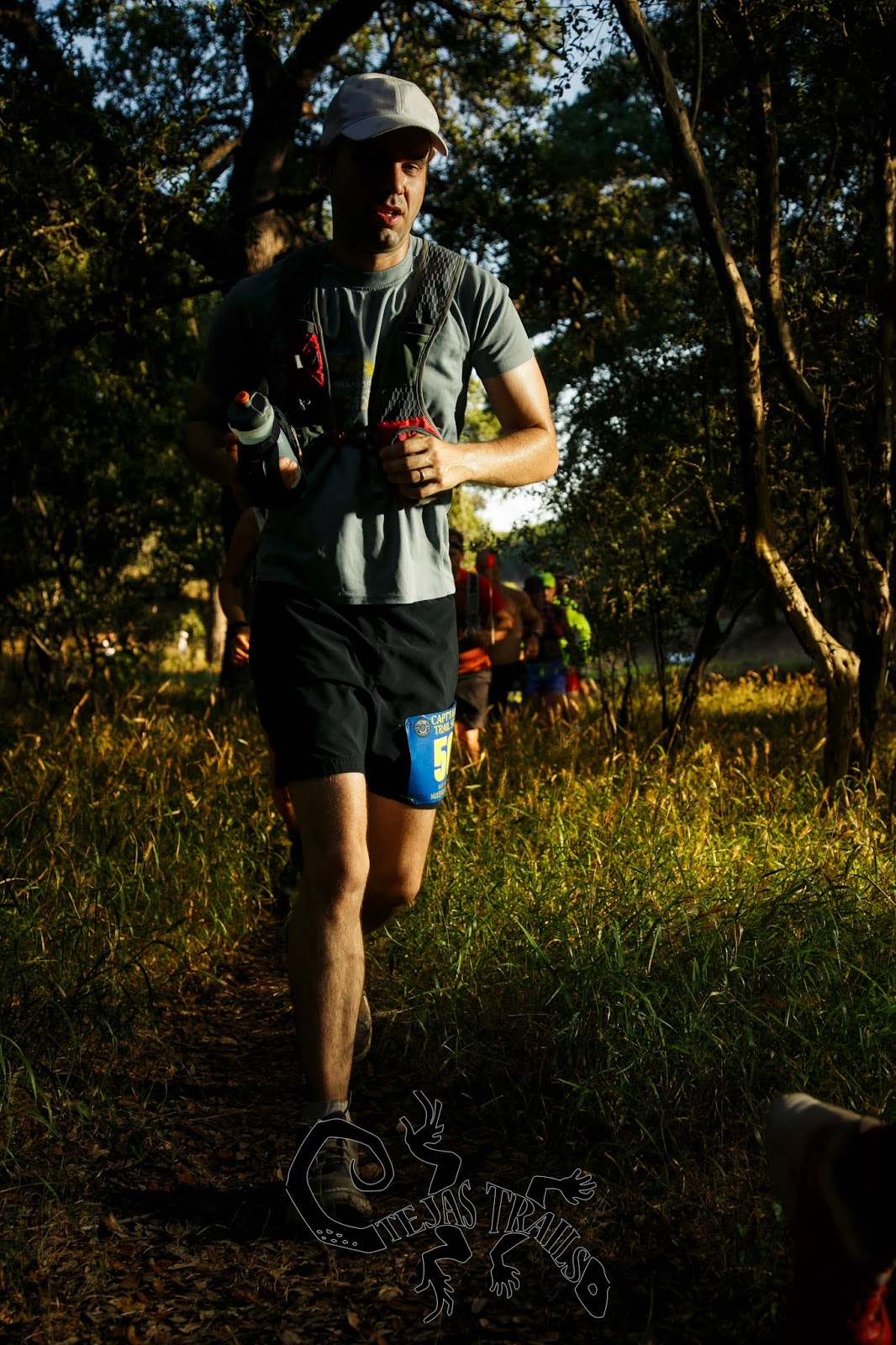
2017 Night Moves Trail Race

When you think about tough race courses, it's usually elevation gain and rocky terrain.  The Night Moves Trail marathon teaches you about the power of sand and grass.

Held in the 7IL Ranch, Night Moves on the surface should not be a grueling race.  No climbing to speak of, starting at 8pm so the Texas heat in August plays a minor role.  But think about this. You know the slow-motion heaviness of running on the beach? You know when there's no more sidewalk and you trudge along the grassy shoulder of a road?  These feelings to me sum up Night Moves, which travels over sandy horse trails and open fields.

I had finally gotten in some consistent training for this race.  After running a couple off-the-couch half marathons to motivate myself to get back into running, I had experienced some sharp calf pain at the Pandora's Box of Rox Marathon which forced me to drop halfway. Then, this July I had the best month of training since my injury in January 2015.

The evening started off hot but with a pleasant breeze.  I had had some twinges on my knee and right foot earlier in the day and was weak from the start.  The plodding pace quickly drained me through the short purple loop (the course consists of short purple loop of less than six miles, red loop 7.9 miles, orange 7.5 miles, long purple 6.3 miles).

I've suffered from back pain off and on since my mid-twenties and early in the race my back seized up.  It probably didn't help that before the race I was hunched over pumping air into the inflatable mattress in the tent for ten minutes.  My posture was impaired for the race and aid station workers asked me if I'd injured my hip.  Each step hurt.

The course was well-marked but in the dark with the open-field running I took a wrong turn on the red loop and ended up at the start well ahead of time.  The race director Rob gave good directions to get back on course.  I moved pretty slowly through the first half of the race.

I always get jitters early in a race, thinking about the long hours ahead. Will I make it? On the orange loop things started clicking and I settled into a groove, picking up the pace a bit and making steady progress.  Still, on the back half of the orange seemed interminable.  Round the corner and there's another long open field.  And another. And another.

Finally making it back to the start I fueled up.  I hadn't used Tailwind before and drank it exclusively during the race; I think it really helped keep up the energy.  I chugged a Red Bull as it was past one am at this point and I've suffered sleep deprivation in past events, though it never came this night.

On the long purple I suddenly decided to run hard, for my midpack abilities anyway.  By this point I knew the grass fields were unpleasant but way more runnable than the sand.  I charged ahead. Though my legs and back hurt, I had energy and it felt like a regular jog after work almost.  Arriving at the final aid station, I asked how far it was to the finish.  Less than three miles.  I had knocked out  half the loop.

I hiked most of the sandy sections, eased by the thought that no matter what I'd be done in less than an hour.  Again, I picked up the pace on the runnable stuff and finished in a sprint.

Interesting wildlife encounters:  three snakes, a rabbit, and a handful of cows on the trail in the middle of the night.

It's been a year since I finished a marathon and it is always a wonderful feeling to finish a long race. Rob, Rachel, and all the volunteers put on a great race and thanks to all!


Tuesday, July 19, 2016

2016 Muleshoe Bend 60k

The Background

The 2016 Muleshoe Bend 60k marked, I hope, the end of a long recovery process from injury. The last race I felt I ran truly well was the 2014 Cactus Rose 100 mile.  Injury at the 2015 Bandera 100k, which was a maddeningly persistent inflammation behind the left knee, took me out of running for nine months.  Though I was able to complete the Wild Hare 50k and Bandera 50k (a drop down from the 100k), these were more shuffling along and getting through the distance.  I never felt strong, never got into a rhythm training.  Between assorted other minor injuries and work demands, I felt like I was just faking it as far as running went.  Sure I'd get in a few runs a week, but I knew I wasn't anywhere close to the runner I was two years ago, physically or mentally. When I mentioned my past ultrarunning to others, I felt like a fraud or as if I was referring to some other person who no longer existed.

Desperate to break free from this dark period, I decided to focus on training for the Arkansas Traveller 100 Miler in October, using Capt'n Karl's Mule Shoe Bend 60k as the first training race to build up to the distance.  Though again my training was far from ideal, I did manage to get in a strong 70 mile week immediately prior to Muleshoe, complete with a trip with the family to Bandera for hill repeats.  I worried if one good week would be enough but I decided to go for it.

The Course

Muleshoe Bend is a deceptively tough course.  Without the extended climbs of races like Bandera or Rough Creek, nevertheless the rocky terrain beats up your legs.

The course consists of a nine mile loop, run four times for the 60k.  The first section the loop of about three miles features some up and down ridge running, which becomes a rockier as you go.  The second section is three and a half miles of very technical terrain, a lot of which is on completely exposed rock.  The third section is two and a half miles of pretty smooth running.

The Race

I started driving to Spicewood at 2pm and arrived about an hour early.  The pre-race atmosphere was festive with Grateful Dead playing, very welcome to this Deadhead.  Incidentally, there were a bunch of motivational posters along the course; three of these were quotes from Dead songs.
Here they are:
"Mama, mama many worlds I've crosses since I first left home." - "Brokedown Palace"
"What a long, strange trip it's been." - "Truckin'"
"Comes a time when the blind man takes your hand says, 'Don't you see?'" - "Comes a Time"
The Dead go quite well with ultrarunning.  These quotes definitely uplifted me!

Loop 1
The whole course is single-track, meaning anytime someone wanted to pass, someone had to step aside.  I tried start in the middle of the pack, but I was slower than I thought and a lot of people wanted by.  I tried to resist the urge to go out too fast, but at the same time I didn't want to be in everyone's way so I tried to keep moving moderately.

Loop 2
I had told myself beforehand to at least run the first two loops, as if worse comes to worse I'd get in an eighteen mile long run.  After that, I'd just run as long as possible and if necessary hike it in.  I made it to the second loop feeling well.  I ran alongside a runner named Jimmy through most of loops two and three and the conversation helped a lot.

Loop 3
All through loop three, I monitored my energy levels and legs, wanting to keep running but hold back something for the final loop.  By the time I passed twenty miles I had run farther than I had since January at Bandera, but I still felt okay.  My legs were starting to get beat up from the rocks but my energy was good.  So far I had only hiked the brief uphills.

Loop 4
Something happened in the final loop.  In the first four miles or so, the pain in my legs disappeared. My energy level went up,  I felt as though I was starting a jog on a Saturday morning, fresh and rested.  Wanting to make use of this, I ran relatively quickly, cruising through the smoother patches of single track.  I passed a few runners, which boosted my morale.

By the time I got to the rocky section in the middle of the loop, the miles started to catch up with me, but I knew now that I would finish in a decent time and resolved to run anything runnable and finish,

Here are my splits:


Lap 1 Gun Time02:00:43
Lap 2 Gun Time02:29:39
Lap 3 Gun Time02:35:53
Lap 4 Gun Time02:33:22
Overall Place24
Division Place5
Gender Place20
I felt very happy with that last loop.

Additionally, when I've run through the night, either at the Capt'n Karls series or at 100 milers, I have always felt a wave of intense sleepiness and dizziness hit me.  This never came.  Perhaps because I was able to continue running, as the sleepiness usually arrived previously in long sections of hiking.


Reflections
As I ran towards the finish line, the emotion of this two-year journey hit me and I started to sprint.  It has been a long journey back, but with Muleshoe Bend I feel like some of the uncertainty and doubt has left me.  It's amazing how much running, or inability to run, can affect one's sense of well-being.  

I'm looking forward to two more training races at least, the Habernero 100k and the Rough Creek 40 miler before the true test in Arkansas in October.

Thanks so much to the race organization, volunteers, and my family for the support! 

2016 Muleshoe Bend 60k

The Background

The 2016 Muleshoe Bend 60k marked, I hope, the end of a long recovery process from injury. The last race I felt I ran truly well was the 2014 Cactus Rose 100 mile.  Injury at the 2015 Bandera 100k, which was a maddeningly persistent inflammation behind the left knee, took me out of running for nine months.  Though I was able to complete the Wild Hare 50k and Bandera 50k (a drop down from the 100k), these were more shuffling along and getting through the distance.  I never felt strong, never got into a rhythm training.  Between assorted other minor injuries and work demands, I felt like I was just faking it as far as running went.  Sure I'd get in a few runs a week, but I knew I wasn't anywhere close to the runner I was two years ago, physically or mentally. When I mentioned my past ultrarunning to others, I felt like a fraud or as if I was referring to some other person who no longer existed.

Desperate to break free from this dark period, I decided to focus on training for the Arkansas Traveller 100 Miler in October, using Capt'n Karl's Mule Shoe Bend 60k as the first training race to build up to the distance.  Though again my training was far from ideal, I did manage to get in a strong 70 mile week immediately prior to Muleshoe, complete with a trip with the family to Bandera for hill repeats.  I worried if one good week would be enough but I decided to go for it.

The Course

Muleshoe Bend is a deceptively tough course.  Without the extended climbs of races like Bandera or Rough Creek, nevertheless the rocky terrain beats up your legs.

The course consists of a nine mile loop, run four times for the 60k.  The first section the loop of about three miles features some up and down ridge running, which becomes a rockier as you go.  The second section is three and a half miles of very technical terrain, a lot of which is on completely exposed rock.  The third section is two and a half miles of pretty smooth running.

The Race

I started driving to Spicewood at 2pm and arrived about an hour early.  The pre-race atmosphere was festive with Grateful Dead playing, very welcome to this Deadhead.  Incidentally, there were a bunch of motivational posters along the course; three of these were quotes from Dead songs.
Here they are:
"Mama, mama many worlds I've crosses since I first left home" - "Brokedown Palace"
"What a long, strange trip it's been" - "Truckin'"
"Comes a time when the blind man takes your hand says, 'Don't you see?'" - "Comes a Time"
The Dead go quite well with ultrarunning.  These quotes definitely uplifted me!

Loop 1
The whole course is single-track, meaning anytime someone wanted to pass, someone had to step aside.  I tried start in the middle of the pack, but I was slower than I thought and a lot of people wanted by.  I tried to resist the urge to go out too fast, but at the same time I didn't want to be in everyone's way so I tried to keep moving moderately.

Loop 2
I had told myself beforehand to at least run the first two loops, as if worse comes to worse I'd get in an eighteen mile long run.  After that, I'd just run as long as possible and if necessary hike it in.  I made it to the second loop feeling well.  I ran alongside a runner named Jimmy through most of loops two and three and the conversation helped a lot.

Loop 3
All through loop three, I monitored my energy levels and legs, wanting to keep running but hold back something for the final loop.  By the time I passed twenty miles I had run farther than I had since January at Bandera, but I still felt okay.  My legs were starting to get beat up from the rocks but my energy was good.  So far I had only hiked the brief uphills.

Loop 4
Something happened in the final loop.  In the first four miles or so, the pain in my legs disappeared. My energy level went up,  I felt as though I was starting a jog on a Saturday morning, fresh and rested.  Wanting to make use of this, I ran relatively quickly, cruising through the smoother patches of single track.  I passed a few runners, which boosted my morale.

By the time I got to the rocky section in the middle of the loop, the miles started to catch up with me, but I knew now that I would finish in a decent time and resolved to run anything runnable and finish,

Here are my splits:


Lap 1 Gun Time02:00:43
Lap 2 Gun Time02:29:39
Lap 3 Gun Time02:35:53
Lap 4 Gun Time02:33:22
Overall Place24
Division Place5
Gender Place20
I felt very happy with that last loop.

Additionally, when I've run through the night, either at the Capt'n Karls series or at 100 milers, I have always felt a wave of intense sleepiness and dizziness hit me.  This never came.  Perhaps because I was able to continue running, as the sleepiness usually arrived previously in long sections of hiking.


Reflections
As I ran towards the finish line, the emotion of this two-year journey hit me and I started to sprint.  It has been a long journey back, but with Muleshoe Bend I feel like some of the uncertainty and doubt has left me.  It's amazing how much running, or inability to run, can affect one's sense of well-being.  

I'm looking forward to two more training races at least, the Habernero 100k and the Rough Creek 40 miler before the true test in Arkansas in October.

Thanks so much to the race organization, volunteers, and my family for the support! 

Tuesday, April 19, 2016

Training Begins

So, training has officially begun for the Arkansas Traveller 100!


For the past few weeks I've been running six miles a day, pretty consistently.  Yesterday was day one of the twenty-four week plan.  Work was closed due to horrible floods in Houston, so I did ten miles in the morning.  Already ahead of schedule!


Onward!

Tuesday, March 15, 2016

Starting Over

So it has been over a year since my hamstring injury at the 2015 Bandera 100k.  After nine months out, my running has been limited and inconsistent.  I finished the Wild Hare and Bandera 50ks, not because I was trained but really just shuffling through them.  Work demands have kept my running schedule sporadic at best.   Plus I really just felt burnt out in general.

But I feel it is time for a change.  I want to get strong again.  The pain in my hamstring, right behind the knee, is still there at a low level.  A doctor said it is capsulitis, but I'm not sure anyone knows what it really is.  Regardless, I want to train.

So my plan is to begin regular running as of now, and build up to the Captain Karl's 60k series this summer.  If all goes well, I can use these as training races for Cactus Rose 100 in October.  If I fall again to injury, so be it.

We'll see what happens...

Wednesday, December 30, 2015

Wild Hare 50k

The Background

It's been quite awhile since I last posted, and a lot has happened.  2015 has been my toughest year as a runner, but thankfully has ended on an up note.

The troubles began at the 2015 Bandera 100k.  A cold, muddy and icy race, it was slip-sliding all the way.  By mile 48 I could no longer bend my left knee and had to drop.  I believe this injury was a combination of the rough conditions, years of over racing and not taking good enough care of myself.  When I was younger, I could eat junk, train a 100 miles a week, and race an ultra every month, but now entering the second half of my 30s gives me cause to reassess.

I was already signed up to race the Rocky Raccoon 100 Miler three weeks later .  I ran not a step between Bandera and Rocky, ran 40 miles on race day, then the hamstring forced me to drop.

What followed turned out to be months sidelined with flaring hamstring pain and physical therapy.
Pretty much every step walking hurt and the healing process seemed excruciatingly slow.

In March, the principal at the campus where I served as AP announced she was leaving.  I did not want to stay to see who would replace her next year, so I went looking for a job.  The stress of this time really illustrated how much I relied on running for peace.

By the end of July I'd found a job writing curriculum for HISD, and the day before I signed my contract my doctor cleared me to run again.

In the eight months of no running, I'd gained 15 pounds and fallen into an unhealthy diet.  It felt like my body was decomposing.  My first run, I could barely make it through a mike and a half.

I slowly upped my mileage and set my sights in the Rough Creek Half Marathon in September.  The 2012 Rough Creek 40 Miler had been my first ultra finish and I'd run the race every year since.  The 40 miler was out of the question, but I wanted to try the half as this would be the final running of Rough Creek.  I managed to finish in about three hours.

My new job kept me busy, so my plans of transitioning into ultra training fell by the wayside.  By November I felt I needed to shake things up.  I signed up for the Wild Hare 50k a week before the race, with no so much as a ten miler in the past two months.

The Race


Prerace

The Wild Hare 50k would consist of four 7.8 mile loops.  The first couple of miles is twisty, turny bike trails.  The conditions were muddy requiring wading through water up to your knees.  Then follows some roller coaster ridge running, before breaking through to open fields.

The first loop was uneventful; I felt happy to be back in an ultra and was taking the pace easy.  In the second loop I slowed considerably.  Often on runs I'll sort out work problems in my head, but for the first time in a race I fell deeply into thought about a project.  Thankfully, this slowed my pace and left me something for the finish.

By the third loop, my legs were pretty sore.  I'd run the race well but I could feel the lack of long training runs.  I went into a mini low point but nothing major.

Beginning the fourth loop, a runner said hello to me and soon we fell into conversation, using talk to escape the mind games that can plague the final miles of a race.  We separated a few miles before the finish but by that time I was just excited about the prospect of completing an ultra after a season of injury.

Crossing the finish line was emotional for me.  After months of pain, frustration, and depression, I was an ultra runner again.


Reflections


This year taught me how much I'd taken running for granted.  I need to take a healthy dose of moderation in my running from here on out, as I'd rather race less than face injury again.  On the other hand, this year taught me that I'm not the invincible runner I thought I was, and injury needs to be taken with stoicism.  It will come again and needs to be thought of as part of the process of a running life.

Nevertheless,  I'm thrilled to be running again.  I'm not 100% and the hamstring still is inflamed at times.  But I've learned to think of what running I can manage as a gift and I'm thankful.

Monday, October 27, 2014

2014 Cactus Rose 100 Race Report

The Background

I had no idea if I'd adequately prepared for Cactus Rose in the weeks before the race. A sprained ankle had cut a week and a half out of the heart of the training season and my one training race, the Rough Creek 40 miler, had been a slog.  I had become much less obsessive about my training this year, running more by feel, not carrying GPS, not logging my miles.  Running and racing is becoming less competitive for me and more of a spiritual exercise, a chance to practice mindfulness, connect with nature and the universe, and test my limits.  Sure, I still like to look at race results and chase down headlamps, but becoming less obsessive on results and more focused on the journey has led to a peaceful feeling of acceptance.  If nothing else, stoicism helps when you're an average runner like me who tends to have major meltdowns at races.

That said, I did put in one long night run three weeks out from Cactus, a 32 miler in the George Mitchell Nature Preserve.  I did 19 repeats of a mile and half loop then ran home.  Heading out Friday after work as the sun set, the main goal was to experience the sleep deprivation that had plagued me at Rocky Raccoon 100.  I cruised through the miles and never got sleepy, so the zombie factor was still a big question mark for Cactus.

I had planned to do one more 20 miler Sunday two weeks out from the race but I hurt my back moving a piano.  The back pain went away in a day, luckily. I ran a ten miler the weekend before Cactus and that was it.  This would be an experiment, to see if less structured training and a lot of rest would lead to me to perform well or crash and burn.

The Course

There is something magical and otherworldly about the Hill Country State Natural Area.  The towering hills, rocky trails, and sotol patches feel like a combination of an old cowboy movie set and an alien planet.

Cactus Rose 100 is consists of four 25 mile loops with aid stations roughly five miles apart.  The first loop aids go Lodge > Equestrian  > Nachos > Equestrian > Boyles > Lodge.  The first ten miles to Nachos, with the exception of the short climb up Lucky's Peak, is very runnable, though this being Bandera there are still a lot of rocks.  Nachos > Equestrian gets tougher with Ice Cream Hill and a couple other climbs.  Equestrian > Boyles is in my opinion the toughest stretch with many steep climbs like Three Sisters and Sky Island.  Boyles > Lodge features the big climbs of Boyles Bump and Cairn's Climb.  You can make good time on this section though because you run fairly smooth trail atop these hills and then there is a mile of runnable trail back to the lodge. 

After each loop you reverse directions.  That means for 100 milers miles 0-10, 40-60, and 90-100 are pretty runnable with tough sections of hills for miles 15-35 and 65-85.


The Race 

My family and I camped in the field and I had trouble sleeping the night before the race.  I got around three or four hours sleep, which was more than before Rocky Raccoon, but I was definitely nervous about Saturday night.

We headed out at 5am in a trail of headlamps into the dark hills.  My strategy was to get through the first 50 miles feeling as good as possible.  I ran very conservatively, letting people pass me, reminding myself to run my own race, finishing the first loop in 5:46.  I had a mini low point at the beginning of the second loop, probably just because I was behind on my nutrition, but overall I was feeling fresh through around 35 miles.

This was to be the hottest year in race history with a high of 84.  At Rough Creek 40 last month it was in the mid 90s with no shade, so that heat training would be of use.  Still, as the midday sun beat down my energy drained and I went into another low. 

At mile 50, I would pick up my music.  This happened to be when the sun lowered in the sky, and the combination of the drop in heat and the Grateful Dead raised my spirits.  I cruised and sang along into the night through mile 70 or so.

Then atop Boyles Bump the sleep fatigue set in.  This time it was even worse than at Rocky.  Becoming disorientated, I staggered along the trail.  I lied down several times along a flat rock or simply on a mess of stones, trying to sleep for a minute or two.  I couldn't sleep nor see how to continue.  Wanting so badly to drop the race, I held in my mind my kids, not wanting them to see me as a quitter.  I know that every ultrarunner has to face DNFs and there is no shame in pushing yourself to the limits and falling short of your dreams.  But I knew the pain of giving up would be worse than enduring this light-headed zombie stagger.

Luckily, fellow runners came to my aid, as I chatted with a couple of folks along the trail, one of whom was in them same shape as I and hallucinating.  We both made it to Boyles aid and tried to sleep.  I lied down on the dirt with my pack as my pillow for maybe ten minutes, still unable to sleep. 
At this point, I was at mile 80 at 6:00 or so in the morning.  I knew then sun would soon rise and might revive me.  Dreading to head out into the cold night, I shuffled out into the darkness. 

As the rays of sun shone out over the hills of Bandera, my fatigue lifted and I rallied.  I began running hard.  I had dropped the music as my head couldn't handle it but instead I was inspired by the awesome beauty of the landscape and the power of nature.  The ancient forces at work humbled me, the night bringing on sleep and the sun energy.


Dawn at mile 86 or so

Wanting to make use of this surge to finish, as I battled the last 15 miles I would pick a runnable section, check my watch, and tell myself to run hard for ten minutes.  Sometimes, at the end of ten I'd be going downhill and stretch it a little longer.

Finally, I made it over Lucky's Peak with a mile to the finish.  I sprinted down the trail, overcome with emotion, and ran across the line with my kids. My time was 31:37.

Loop 1
05:46:14
Loop 2
07:45:33
Loop 3
09:21:45
Loop 4
08:43:38


Reflections

For a middle of the pack runner like me, this race was about as good of a performance as I could have hoped for.  I could definitely cut time by being more efficient at the aid stations.  My goal for this race was just to finish and I sat and chugged coke and ate Pringles at the aid, which added up on the clock.  This kept me going but for a race with a time goal I could cut this down by eating on the trail.  And if I could figure out this sleep deprivation thing, either by simply getting a good night's sleep beforehand or coming up with a better coping strategy, that would help.  But I didn't give up when things seemed lost and fought the whole way.  At Rocky, I'd really only run hard the last five miles or so but here I ran steadily through sections in the last 50 miles.

Another reminder from this race was how decent and good most ultrarunners are.  In addition to those who kept me sane during my sleep breakdown, a moment that stuck with me was when I arrived at Bandera, trying to set up my tent, get my family situated, then find the aid stations to place my drop bags in the dark.  A guy named Chip walked me to Boyles and chatted with me, helping a total stranger for no reason.  It's a great feeling to be part of our little community.  To Joe, Joyce, Tejas Trails, all the volunteers and runners, thanks for helping me along the way.